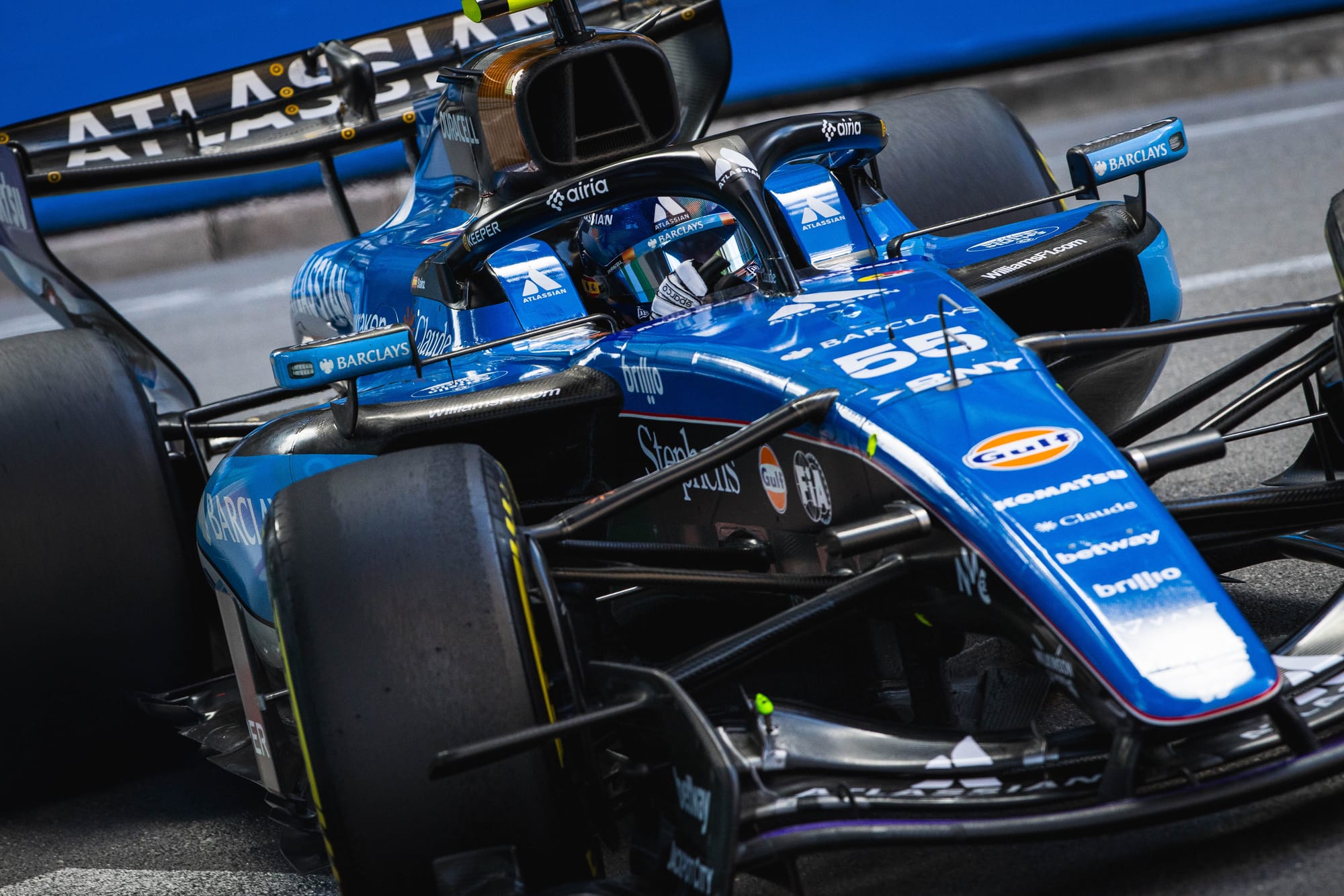
In the high-octane world of Formula 1, where the spotlight rarely strays from the front-runners, Carlos Sainz is quietly crafting a season that deserves far more attention than it’s getting. The Williams driver has been toiling in the lower midfield, but his performances relative to his machinery have been nothing short of stellar. Yet, as is often the case for those driving uncompetitive cars, his efforts have gone largely unnoticed—except when he makes a mistake.
Sainz’s most memorable moment of 2026 so far was an unfortunate clash with race leader Oscar Piastri while being lapped in Hungary. That blunder drew criticism, but it stands in stark contrast to the rest of his campaign. In fact, one could argue it was a byproduct of the very mindset that has made him so impressive this year: a refusal to yield, even when the reward is seemingly nonexistent.
Fighting for Every Position
The Williams FW48 is, on average pace, the third-slowest car on the grid, ahead of only Cadillac. For a driver who spent years fighting at the front with Ferrari, this would be a soul-crushing situation. But Sainz, at 31, knows he can’t afford to ease off. His future in the sport depends on maintaining his reputation, and he’s determined to leave nothing on the table.
This relentless approach was on full display in Hungary, where Piastri criticized Sainz for "fighting Fernando [Alonso] for last place like it was the world championship." To some, that might seem pointless. But it’s exactly this mentality that has allowed Sainz to extract every ounce of performance from a limited car. He’s dragged the Williams into Q2 on ten occasions out of fifteen, and he’s been outpaced by teammate Alex Albon only twice, both times by thousandths of a second.
His results—a trio of ninth places and just six points—might be the worst stretch of his career in terms of raw numbers. But when you consider the machinery, it’s a different story. In the driver rankings compiled by The Race, which evaluate each driver’s performance across a race weekend, Sainz sits fifth in 2026. That’s a testament to his consistency and skill, even when the car is not up to the task.
A Natural Approach
What’s behind this impressive form? Sainz points to a combination of preparation and instinct. He’s worked closely with his engineering team to understand the new 2026 regulations, particularly around energy management and tire usage. But once he’s in the car, he relies on pure instinct—a stark contrast to the ground-effect era, where he had to adapt his driving style to be more disciplined.
"I never drove the ground-effect cars naturally," Sainz explained. "I had to change my driving to adapt. When I started this year, I said, ‘Clean sheet of paper, I’m going to forget the ground effect and go back to driving as naturally as I can.’" That approach has paid off. The lower-downforce cars require a driver who is comfortable with the tiny slides and can carry momentum, and Sainz’s natural style seems to suit them perfectly.
He’s also been helped by a second year with Williams. "It’s a typical transition in a second year with a team," he said. "You normally become one tenth quicker." That settling-in process has allowed him to build a stronger rapport with his engineer and better understand the car’s quirks.
Albon’s Struggles
Sainz’s performance has also highlighted the difficulties faced by his teammate, Alex Albon. Albon has had his fair share of problems in a troubled season for Williams, and his style hasn’t gelled as well with the new cars. But Sainz is quick to defend him. "Alex has had weekends where he’s been really competitive," he said. "I wouldn’t doubt Alex. In every corner I do, there are data points from him that I’m always copying."
Sainz’s own consistency is remarkable. He’s often taken a Q1-level car into Q2, and on multiple occasions, he’s held off faster machinery. In China, he kept Franco Colapinto’s delayed Alpine behind to finish ninth. These are the kind of performances that don’t make headlines but are the mark of a truly great driver.
A Case for His Best Season
Could this be Sainz’s best season in F1? He’s reluctant to say so, given his lowly position in the championship. "I hate thinking like that because I’m P16," he admitted. "It’s a very ‘relative’ sport. How can you tell a fan that’s your best season? It’s completely counterintuitive." But when you isolate the car from the driver, the argument is compelling.
Sainz ranks his McLaren years, his 2024 season with Ferrari, and the second half of 2025 with Williams as his best. But he concedes that this year is up there. "If I isolate the car versus the driving, it’s one of my most complete seasons," he said.
As the season progresses, Sainz will continue to fight for every position, even if it seems meaningless. It’s that fighting spirit that defines him, and it’s why he remains one of the most respected drivers on the grid. While the results may not show it, Carlos Sainz is having a year to remember.