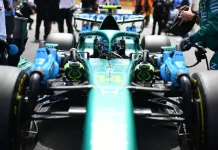
In total contrast to last year, Red Bull came alive at Monza. That was all Max Verstappen needed to rip pole position away from McLaren – and Ferrari – for the fifth time this season. And he didn’t just take pole. He smashed history, setting the fastest Formula 1 qualifying lap ever recorded, with an average of 164.465mph.
Monza, the wild outlier of low-downforce extremes, always promised to blunt McLaren’s overwhelming advantage. Their aero efficiency at high-downforce tracks has been devastating, but strip the wings right down to Monza levels and suddenly Red Bull and Ferrari are very much in the fight.
With Monza’s staggering percentage of full-throttle running, and so few corners where grip and traction are the limiting factors, McLaren’s supremacy was clipped. For Ferrari, strong at Monza has long been tradition. For Red Bull, not so much historically – but this year the RB21 has shown it thrives when the wings come off.
So we had a three-team showdown for pole: Ferrari, Red Bull and McLaren – each running different wing levels, from lowest to highest.
It should have come down to who could grab the perfect tow. A well-executed slipstream here is worth up to 0.25–0.3s, far bigger than the raw difference between the cars. But no team truly played the game.
At McLaren, with both drivers locked in a title battle, there was no way to politically justify prioritising one over the other. Even alternating the tow in Q3 would’ve been messy, as the track is always quicker on the final runs. In the end, McLaren backed away from the risk and just trusted the car’s natural pace.
At Red Bull, Yuki Tsunoda was handed the towing role once he scraped into Q3. On the first runs he pulled Verstappen to provisional pole. But then Tsunoda’s car suffered a battery failure, leaving Max on his own for the decisive laps.
Ferrari looked best placed to deploy the tactic, just as in 2022 when Carlos Sainz – taking grid penalties – dragged Charles Leclerc to pole. But this time, they didn’t even try. On both Q3 runs, Leclerc left the pits ahead of Hamilton instead.
“Because of the regulation about maximum time [of the out-lap], you are sacrificing one car,” explained Ferrari boss Fred Vasseur. “It could work, but it was risky. It was more important to focus on tyre preparation.”
In other words, if the slipstream required a slow out-lap and the Ferrari demanded a hard one, the gain would be lost. Plus, it risked getting stuck in the pitlane shuffle while others built their gaps.
So, with the tow game essentially abandoned, it became a straight fight: corner entry versus straight-line speed.
Ferrari, with the lowest wings, gained the least from it this year thanks to Monza’s new tarmac and higher grip levels. McLaren, with more wing, should have enjoyed the best corner entry speeds – but Verstappen’s Red Bull delivered everything he needed to rotate perfectly into the chicanes.
The car’s response to his lightning steering inputs was stunning, thanks to Red Bull fine-tuning a slightly fuller front wing. On Friday, it was over-rotating and costing time. By Saturday, it was razor-sharp – and Max unleashed it.
Meanwhile, Lando Norris endured a messy path through qualifying.
“Oh, I was just making too many mistakes,” Norris admitted. “We were not quite in the rhythm, or with the pace advantage we’ve had last few weekends. I was hitting every kerb I didn’t want to hit, locking up.”
In Q2 he locked up at Turn 1 and had to abandon the lap. Going again, his first lap on new tyres was marginal – it would’ve been enough – but his second was much stronger, helped by a helpful tow from Piastri.
Yes, Oscar Piastri was instructed to tow his title rival into Q3. Norris, in turn, went out first in Q3 and got no tow, while Piastri was ahead for the final runs. The tiny slipstream he picked up from Piastri was nowhere near as valuable as the 0.113s Norris had on him.
Still, Norris was 0.077s short of Verstappen, who ironically picked up a small tow from Norris himself. The slipstream didn’t decide the fight – Max’s precision did.
Ferrari had to swallow fourth and fifth – Leclerc ahead of Hamilton – a couple of tenths adrift. On this resurfaced high-grip Monza, ultra-low drag simply wasn’t as powerful as in past years. A touch more wing, especially on the front, bought you more time in the chicanes.
“I’m very happy with my lap in Q3 and P4 was the maximum result we could extract from our car today,” said Leclerc. With hindsight, they’d have needed the perfect tow to close the gap.
Mercedes never really figured. George Russell was only sixth-fastest (promoted to fifth after Hamilton’s penalty), about 0.15s off Leclerc. And he was furious about tyres.
Russell had wanted mediums for Q3, after topping Q1 with them. The harder compound gave more security and suited Mercedes’ rapid warm-up traits. But the message was lost in translation.
He thought “sticking to the plan” meant mediums. The team thought it meant softs. “I should have made myself clearer,” Russell admitted.
So, here we are: McLaren may well have the better race pace, but Verstappen has the one thing that matters most – track position. In what’s expected to be a one-stop race, that could be decisive.