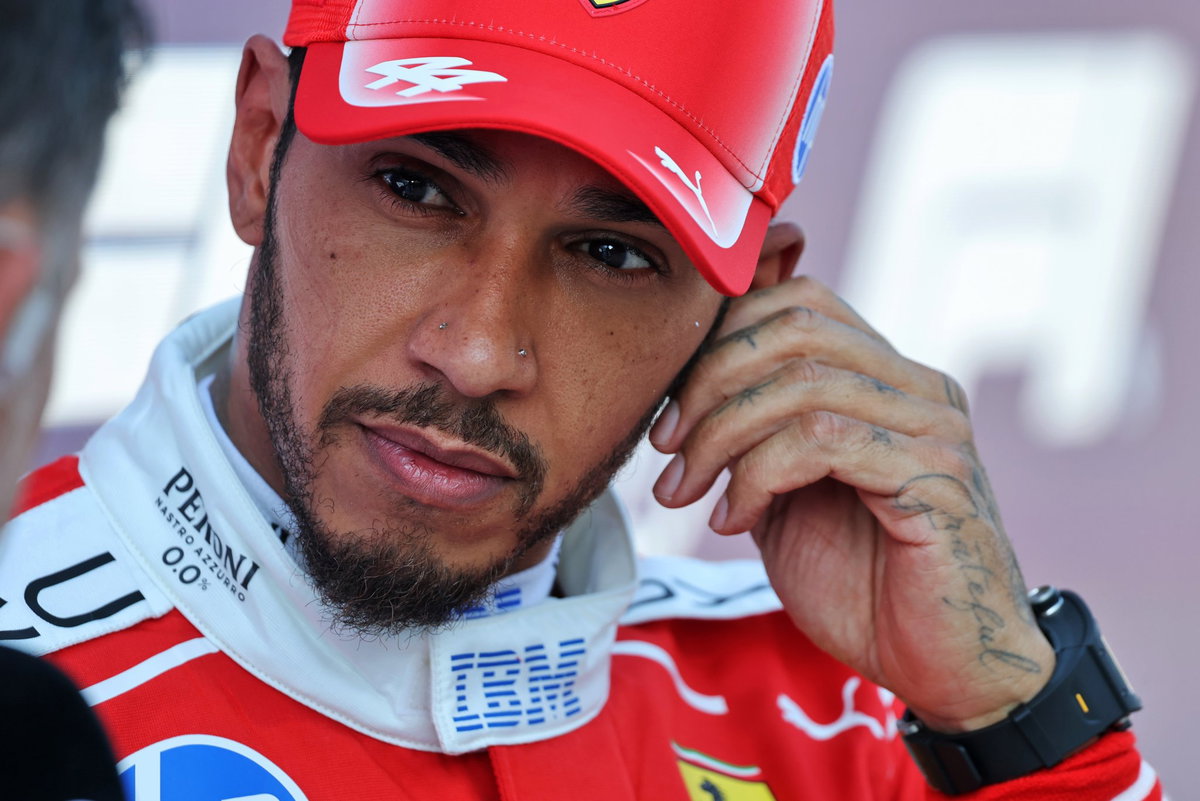
Lewis Hamilton has pushed back against the persistent narrative that he has struggled to adapt to Formula 1’s ground effect regulations, pointing to his renewed form as evidence that the criticism was misplaced. The seven-time world champion’s comments come after a string of strong performances that have silenced doubts about his ability to extract performance from the current generation of cars.
Since the introduction of ground effect aerodynamics in 2022, Hamilton has faced intense scrutiny. Early struggles, including a winless 2022 season and a challenging 2023 campaign, led many to speculate that the new regulations had exposed a weakness in his driving style. Critics argued that the stiffer, lower-slung cars did not suit his natural feel for oversteer and rear grip, and that younger teammates were better equipped to handle the shift.
However, Hamilton has consistently rejected that framing. In recent interviews, he has emphasized that the difficulties were more about the car’s inconsistency than his inability to adapt. "I’ve always been able to adapt to whatever the regulations throw at us," he said. "The ground effect era has been a challenge for everyone, but I’ve never doubted my ability to get the most out of the machinery."
The statistics support his case. After a difficult start to the 2024 season, Hamilton has reeled off a series of podium finishes and a victory that reminded everyone of his class. His qualifying pace has improved markedly, and he has consistently outscored his teammate over the past several races. Team principal Toto Wolff has also defended Hamilton, noting that the car’s development trajectory has finally given him a platform to showcase his talent.
A Narrative Built on Circumstance
The "ground effect struggles" narrative took hold largely because of Hamilton’s uncharacteristic dip in form during the first two seasons of the regulation cycle. In 2022, he finished sixth in the standings, his worst result since his rookie year. In 2023, he managed just six podiums and no wins, while his teammate George Russell often looked quicker. But those results were heavily influenced by Mercedes’ flawed car concept, which suffered from excessive bouncing and a narrow operating window.
Hamilton’s driving style, which relies on a stable rear end and the ability to rotate the car on corner entry, was particularly hampered by the unpredictable balance. He often complained of a "knife-edge" feeling, and the team struggled to give him a car he could trust. As Mercedes gradually abandoned the zero-sidepod concept and adopted a more conventional design, Hamilton’s performances began to improve. By the end of 2023, he was regularly challenging for podiums again.
His recent resurgence has been dramatic. In the last five races, he has finished on the podium four times, including a dominant win at Silverstone that drew emotional scenes. He has also been more consistent in qualifying, often putting his car on the front row. This upturn has led many pundits to revise their assessments, acknowledging that Hamilton’s earlier struggles were more about the car than the driver.
The Bigger Picture
Hamilton’s dispute with the ground effect narrative is not just about personal pride. It also speaks to a broader debate about how drivers are judged in an era of highly complex, regulation-heavy cars. In the past, a driver’s skill could often overcome machinery deficiencies, but modern F1 is so dependent on aerodynamics and setup that even the greatest talents are at the mercy of their engineers.
For Hamilton, the stakes are high. At 39, he is fighting for a record eighth world title, and any suggestion that he is past his prime could affect his legacy. By pushing back against the narrative, he is reasserting his place among the sport’s elite. His recent performances have done more than any words to convince skeptics.
As the season progresses, Hamilton will look to build on his momentum. The championship battle is tight, and he remains within striking distance of the lead. If he can maintain his current form, the ground effect era may ultimately be remembered not as the period when Hamilton struggled, but as the time when he proved his doubters wrong.
In the end, Hamilton’s message is clear: don’t write him off. The ground effect cars may have presented a challenge, but he has met it head-on. And with each passing race, he is rewriting the story of his career in this new era.