

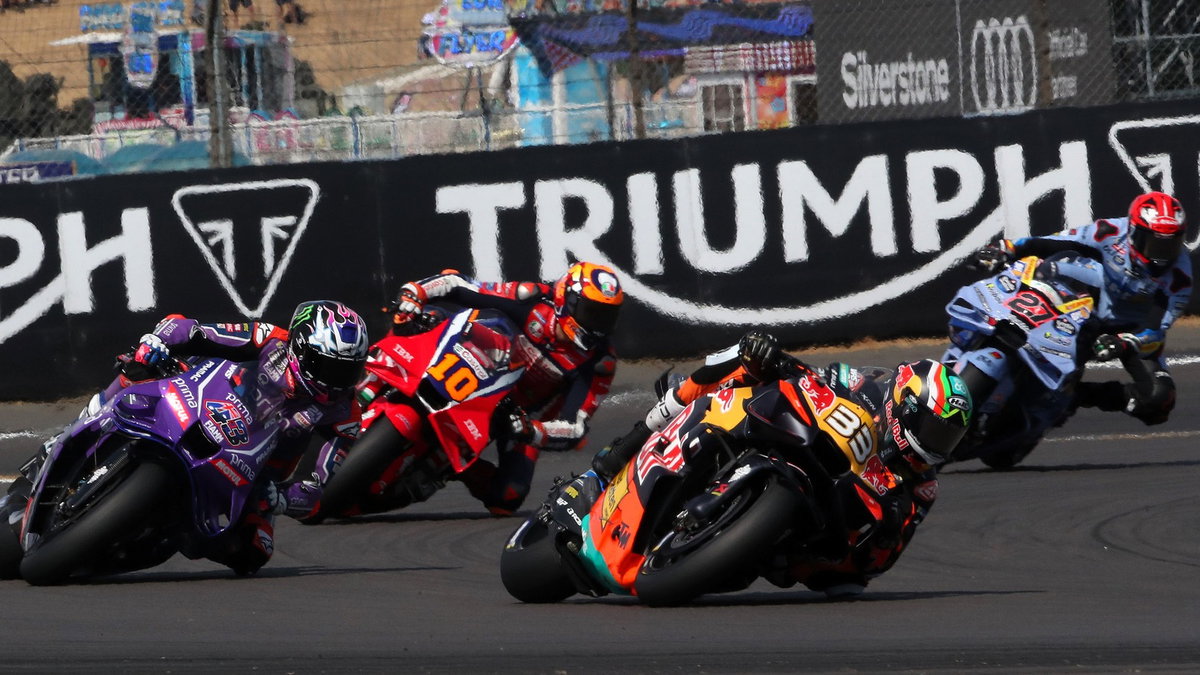
Silverstone delivered yet another dramatic chapter in the 2026 MotoGP season, and for Brad Binder, it was a race of what might have been. The South African rider, known for his aggressive and fearless style, found himself in an unusual position—one where he had to hold back. Speaking after the British Grand Prix, Binder conceded that he may have been ‘a bit too kind’ to his rear tyre, a decision that left him ‘floating’ in the latter stages of the race.
Binder’s admission highlights the delicate balance MotoGP riders must strike between preserving their tyres and pushing to the limit. At Silverstone, a circuit notorious for its high-speed corners and abrasive surface, tyre management is often the defining factor. The 2026 race proved no exception, with riders grappling with extreme degradation as the laps ticked by.
From the outset, Binder looked competitive, slotting into the leading group and demonstrating the kind of pace that has made him a consistent podium contender. But as the race progressed, it became clear that his approach was more conservative than some of his rivals. Rather than attacking every corner, Binder opted to protect his rear tyre, a strategy that seemed sensible in the early stages but ultimately cost him in the closing laps.
‘I think I was a bit too kind to the rear tyre,’ Binder said, reflecting on his performance. ‘I was trying to save it for the end, but maybe I overdid it. The last few laps, I was just floating, not really able to push like I wanted.’
The term ‘floating’ is telling. In MotoGP, it describes a sensation when the rear tyre loses grip and the bike feels unstable, making it difficult to maintain speed or change direction. For a rider like Binder, who thrives on rear-grip confidence, that feeling is particularly frustrating.
Binder’s strategy was not without logic. Silverstone’s layout punishes riders who overuse their tyres early, and many have fallen victim to late-race drops in performance. But by being too conservative, Binder left himself with no margin to challenge the front runners when it mattered most. The result was a race that slipped away, leaving him to settle for a position that did not reflect his true potential.
The Silverstone race was a microcosm of the 2026 MotoGP season, where tyre management has become an art form. The introduction of new rear tyre compounds has shifted the competitive balance, rewarding those who can extract maximum performance over a full race distance without destroying their rubber. Binder’s experience at Silverstone serves as a reminder that even the most talented riders can get it wrong.
For Binder, the key takeaway is a need to find a middle ground. ‘It’s a learning process,’ he said. ‘You have to be smart, but you also have to be aggressive. I think I can find a better balance next time.’
The South African’s honesty is refreshing in a sport where riders often deflect blame or hide behind excuses. His willingness to admit a strategic error shows a maturity that will serve him well as the season progresses. With several rounds still to go, Binder will have ample opportunity to apply the lessons learned at Silverstone.
Looking ahead, Binder and his team will analyse the data from Silverstone to understand exactly where they lost time. The goal will be to refine their approach for the remaining races, ensuring that Binder can push to his limits without compromising his tyres. It’s a fine line, but one that separates the good from the great in MotoGP.
The British Grand Prix also underscored the importance of adaptability. Riders who could adjust their riding style mid-race reaped the rewards, while those who stuck to a rigid plan struggled. Binder’s ‘too kind’ approach was a gamble that didn’t pay off, but it was a calculated risk that could easily have worked in different conditions.
As the MotoGP paddock moves on to the next round, Binder will be eager to put Silverstone behind him. But the lessons learned will linger. In a championship where every point counts, the ability to manage tyres effectively is as crucial as raw speed. Binder has the speed; now he needs to perfect the management.
Fans of the #33 rider will be hoping that his Silverstone experience proves to be a turning point. If he can channel that aggression while being mindful of his tyres, he could be a force to be reckoned with in the races to come. For now, though, Binder is left to reflect on a race where he was perhaps too kind—and ended up floating when he needed to fly.


